
How-to
Rushing or dragging? Find out which one you actually do
A ten-minute drill that measures whether you play ahead of the click or behind it, by how many milliseconds, and whether it's you or your headphones.
Every drummer has a direction. Some of us creep ahead of the click, especially going into a fill. Some of us sit behind it and call it laid back. Most of us don't know which one we are, because the ear is a bad judge of its own hands: when you're 15 milliseconds early, it just sounds like you.
This drill takes about ten minutes. It gives you a number, a direction, and a way to tell whether the problem is your time or your gear.
What you need
A practice pad, sticks, and RhythmForge open on the Practice tab.
Round 1: play blind (3 minutes)
- Set the metronome to 80 BPM, 4/4, quarter notes, and turn on listening (the mic button).
- Put the phone where you can't see the screen, but keep the mic uncovered.
- Play quarter notes with the click for three minutes. Nothing fancy: even strokes, same height, same spot on the pad.
Play blind on purpose. While you play, the app shows a live pill: a word for how steady you are (Locked, Steady, Drifting or Erratic) and arrows that lean left when you rush and right when you drag, like Locked slightly rushing. The moment you see it, you'll correct. Round 1 is about what your hands do when nobody's watching.
Reading the results
Stop after three minutes. Any session over 30 seconds is saved, so the results screen comes up. Three things on it answer the question.
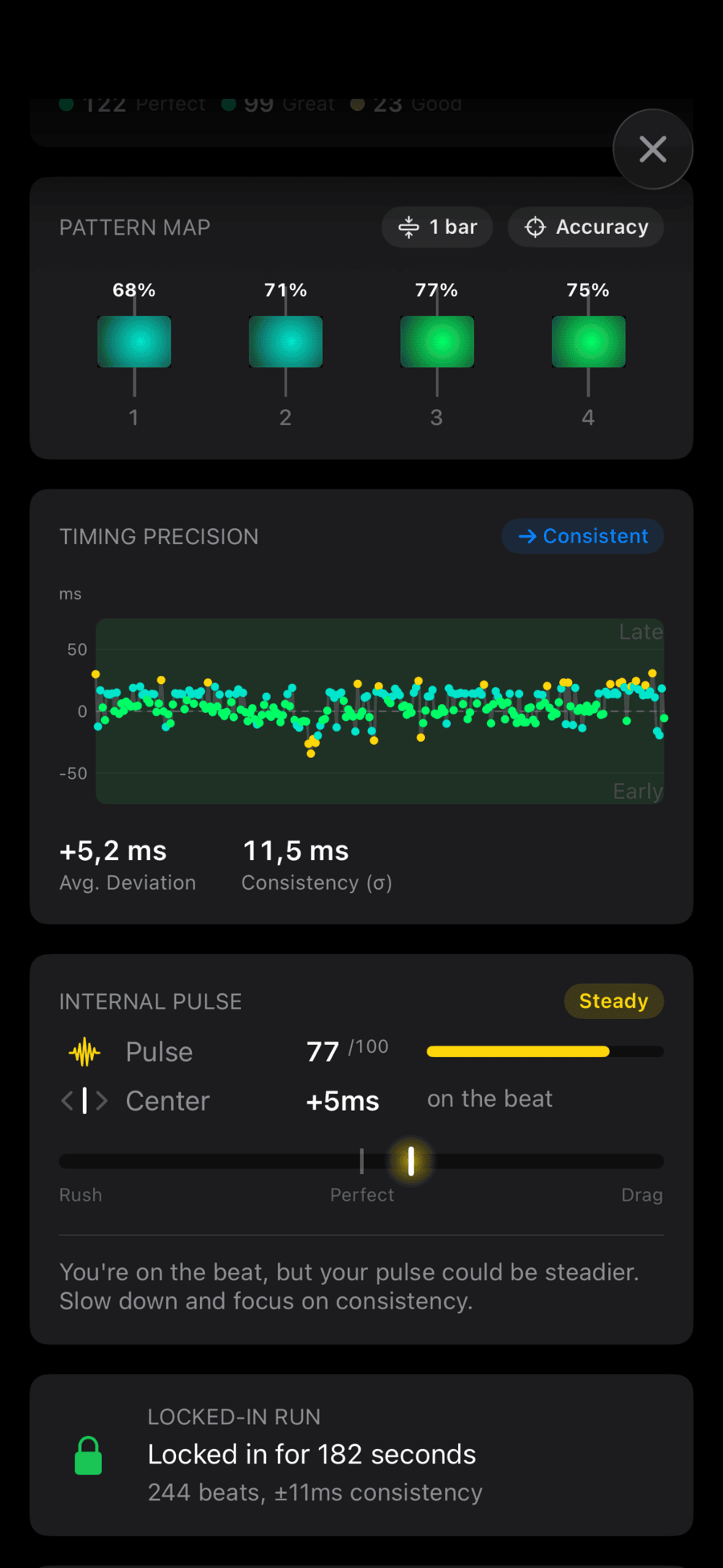
1. The Center value (on the Internal Pulse card). This is your average offset from the click, in milliseconds, with a sign:
- a minus means you're early: rushing
- a plus means you're late: dragging
- within ±10 ms the app calls it on the beat, and so will your ears
It also spells it out: slightly ahead, ahead of the beat, slightly behind, behind the beat. The 10 ms line isn't arbitrary: it's the same window a hit needs to count as Perfect. Inside it, nobody can hear the difference.
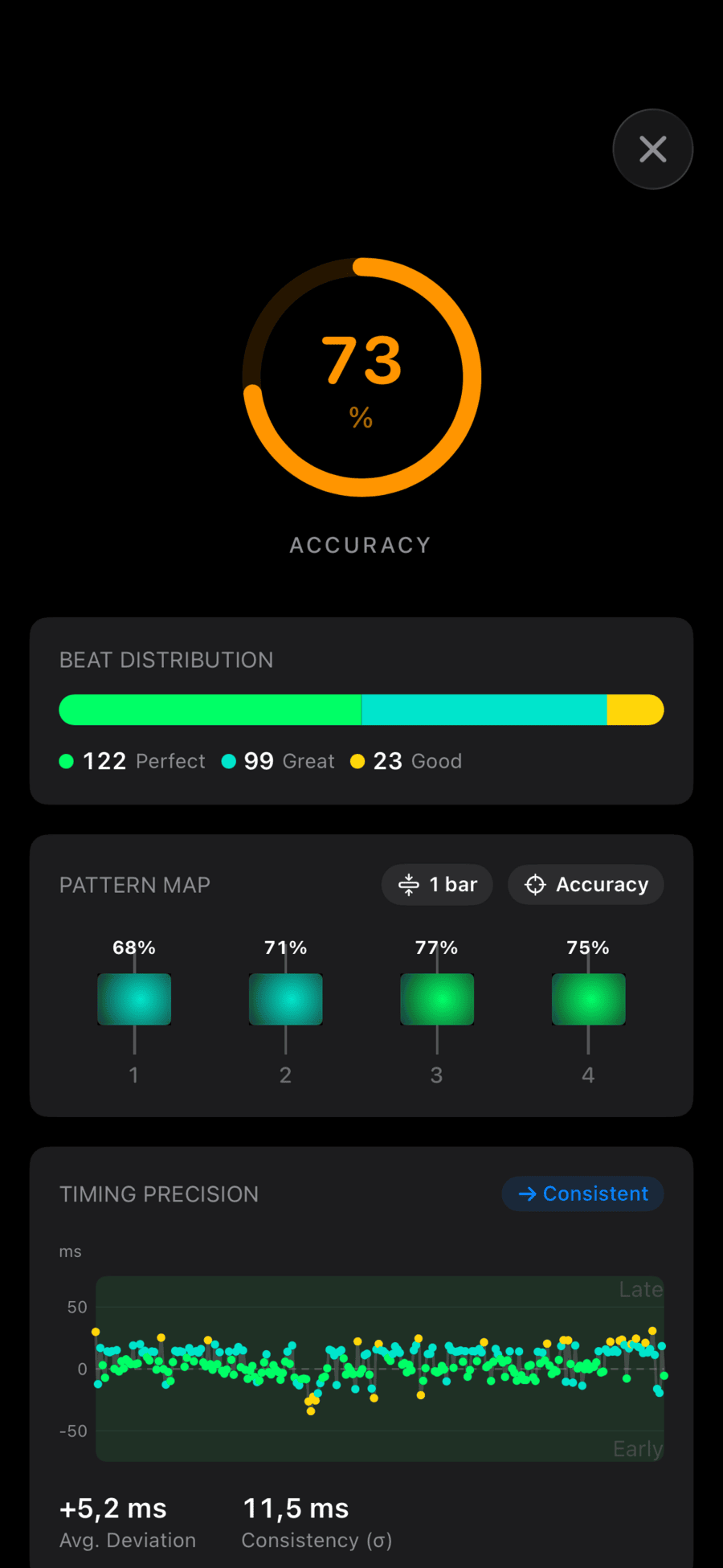
2. The Timing Precision chart. Every beat is a dot: above the line is late, below is early. Look at the shape, not just the average:
- a cloud sitting below the line the whole way is a steady rush
- a cloud that starts on the line and sinks is speeding up; if the drift is big enough to be real, the Tempo Pull card says Speeding up (or Slowing if it rises), with roughly how many milliseconds a minute
Those are different problems. A steady rush is a habit. Speeding up is usually tension or excitement building over the three minutes.
3. Consistency (σ), under the chart. This is how spread out your hits are, in milliseconds. It matters here because a small average can hide a wide spread: +2 ms average with ±30 ms consistency means you're early half the time and late the other half, and it cancels out on paper.

Round 2: watch the pill (3 minutes)
Same tempo, same pattern, screen where you can see it. Now watch the pill under the status line. It reads your last five seconds and moves with every hit, so it tells you what you're doing now, not what you did a minute ago.
Notice when the arrows show up at all. They only point once you're Locked or Steady, meaning your spread (the same consistency number as on the results screen) is under 25 ms. At Drifting or Erratic they stay blank, because the average of scattered hits doesn't say anything yet. Get steady first, then worry about direction.
When it says you're rushing, don't try to "play later". That usually overcorrects into a drag. Relax the next few strokes instead: let the stick fall rather than throwing it. When it says you're dragging, listen for the click through your stroke rather than waiting for it before you move.
Compare the two Center values. The gap between blind and watched is how much you can correct when you're paying attention. Most of the work from here is making Round 1 look like Round 2.
When I ran it, my blind round came out at +5 ms: on the beat, but a hair behind, with 11.5 ms consistency and 73% accuracy. Watching the pill, the same three minutes landed at −1 ms, 10.3 ms and 81%. That could have been warm-up, so a couple of days later I ran it the other way round, five minutes each, watching first. I started cold and sat about 9 ms late for the first minute and a half, until the pill pulled me in; after that I stayed within a millisecond of the click. Blind, second and warmed up, I went back to +3 ms, with looser consistency (12.5 ms) and 75%. Two runs aren't proof, but the direction held both times: I sit slightly late when I'm not looking, and I can pull it back when I am.
The catch: is it you, or your audio?
One reading on the Internal Pulse card needs a second look: Locked in, off the beat. Your hits are tight (consistency is good), but they all sit the same distance from the click, say −18 ms every time. (If it says Steady, off the beat instead, your hits are looser; work on consistency before you blame the gear.)
That can be a real habit. But if it's the same number every session, on every tempo, it's more likely your audio path: the time between the app playing the click and the click reaching your ears. The app suggests it itself: Try timing calibration in Settings. Settings → Timing Calibration takes about ten seconds of playing along. It measures the delay for the output you're using and stores it separately for the phone speaker, each pair of headphones, and each Bluetooth speaker. (AirPods are a special case: their delay drifts during a session, and the app corrects it while you play. Here's how I measured it.)
Make it a habit
Do Round 1 once a week, same tempo, and note the Center value (your recent sessions are in the Activity tab). You're not chasing zero forever. You're finding out whether your direction changes when you're tired, at faster tempos, or after a week off.
Then try the same drill at 60 BPM. Slow is where rushing hides best. That's the next drill.